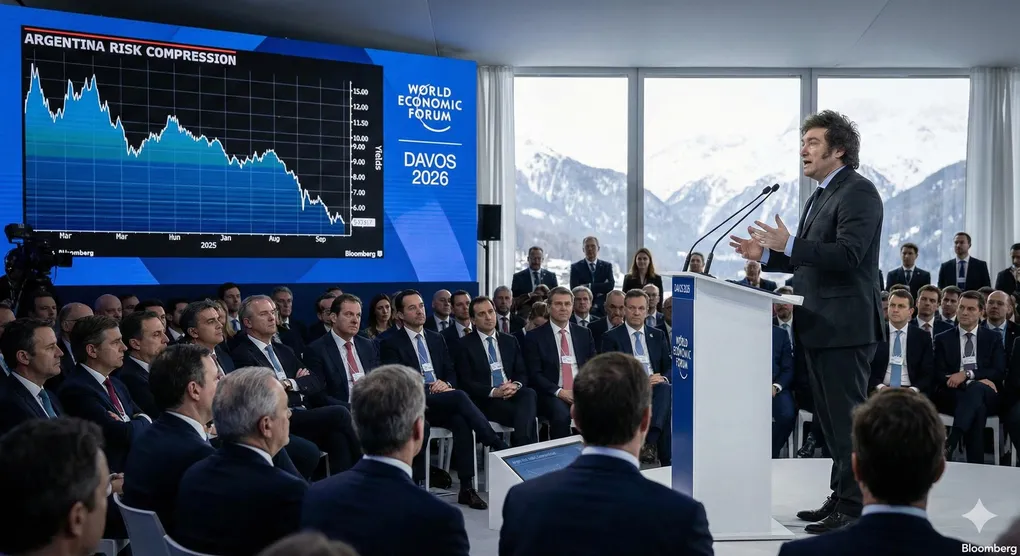
Milei's Davos Doctrine: A Geopolitical Reassertion of Western Capital and Risk Compression
Javier Milei’s address at the World Economic Forum in Davos, delivered on January 11, 2026, was far more than a mere policy outline for Argentina. It was a clarion call, a strategic declaration that reverberates across the geopolitical landscape, signaling a profound re-alignment of values and interests that institutional investors, particularly those prioritizing Western Premium and risk compression, cannot afford to ignore. His unequivocal defense of “Western ethics” and explicit support for a potential Trump administration’s policy towards Venezuela are not isolated statements; they are cornerstones of a nascent, assertive geopolitical doctrine with significant implications for global capital flows and regional stability.
For ‘Smart Money’, Milei’s stance represents a potent signal. In an increasingly fragmented and ideologically contested world, the re-assertion of core Western principles – individual liberty, free markets, property rights, and limited government – from a prominent Latin American leader offers a rare and valuable commodity: ideological clarity. This clarity, when backed by actionable policy, translates directly into reduced political risk and enhanced institutional stability, the very bedrock upon which sustainable investment returns are built.
The Security Angle
Milei’s defense of “Western ethics” is not merely philosophical; it is a strategic security posture. In the context of global power competition, it signifies a clear demarcation line. It implies a commitment to the rule of law, transparent governance, and the protection of private enterprise – principles that are inherently antithetical to the state-centric, often kleptocratic, models prevalent in many non-Western or anti-Western blocs. For institutional investors, this ideological alignment offers a crucial “security premium.” It suggests a nation less susceptible to arbitrary expropriation, less prone to sudden policy shifts driven by populist whims, and more likely to uphold international agreements and property rights.
His explicit endorsement of a potential Trump administration’s Venezuela policy further solidifies this security angle. This is not just about a specific country; it’s about a broader, more assertive stance against authoritarian regimes and their destabilizing influence in the Western Hemisphere. A coordinated, ideologically aligned approach from key regional players like Argentina, potentially backed by a re-energized U.S. foreign policy, could lead to a significant compression of geopolitical risk in Latin America. It signals a willingness to confront and dismantle structures that undermine democratic institutions and free markets, thereby creating a more predictable and secure operating environment for capital.
This alignment also has implications for countering the growing influence of adversarial powers – notably China and Russia – in the region. By firmly anchoring Argentina within the Western sphere of influence, Milei’s doctrine implicitly pushes back against alternative models that often come with opaque financing, debt traps, and a disregard for environmental or labor standards. This strengthens the collective security of Western interests and provides a more reliable framework for long-term strategic investments, reducing the tail risk associated with geopolitical volatility.
The Economic Implication
The economic implications of Milei’s Davos doctrine are profound and directly relevant to institutional investors seeking robust returns within a stable framework. His ideological commitment to free markets, deregulation, and fiscal discipline, now explicitly framed within a “Western ethics” paradigm, is a powerful signal for risk compression. When a nation’s leadership articulates such a clear and consistent vision, it reduces policy uncertainty, which is a primary driver of investment risk. This clarity allows for more accurate valuation models, longer investment horizons, and ultimately, a lower cost of capital.
For Argentina itself, this stance is designed to attract significant foreign direct investment (FDI). By aligning with the core tenets of Western capitalism, Milei is effectively rolling out the red carpet for institutional capital that has historically been wary of Latin American political instability and economic populism. The promise of secure property rights, a stable macroeconomic environment, and a government committed to market-based solutions creates a compelling narrative for long-term capital deployment. This isn’t just about Argentina; it sets a precedent and potentially encourages other nations in the region to consider similar reforms, fostering a broader environment of pro-market stability.
Furthermore, the “Western Premium” comes into sharp focus here. Nations that demonstrably adhere to these principles often benefit from better access to international capital markets, more favorable lending terms, and stronger trade relationships with developed economies. This translates into lower borrowing costs for governments and corporations, enhanced liquidity, and greater resilience against external shocks. Milei’s speech is a direct appeal to this premium, positioning Argentina as a reliable and ideologically compatible partner for Western institutional investors.
While the implementation of such radical reforms will undoubtedly face domestic challenges and may entail short-term volatility, the strategic direction is unmistakable. For institutional investors with a long-term horizon, Milei’s Davos doctrine represents a significant opportunity to capitalize on a nation’s fundamental re-orientation towards principles that have historically underpinned sustained economic growth and wealth creation. It is a strategic pivot that promises not just economic reform, but a re-anchoring within a global order that values and rewards institutional stability and the free flow of capital.